
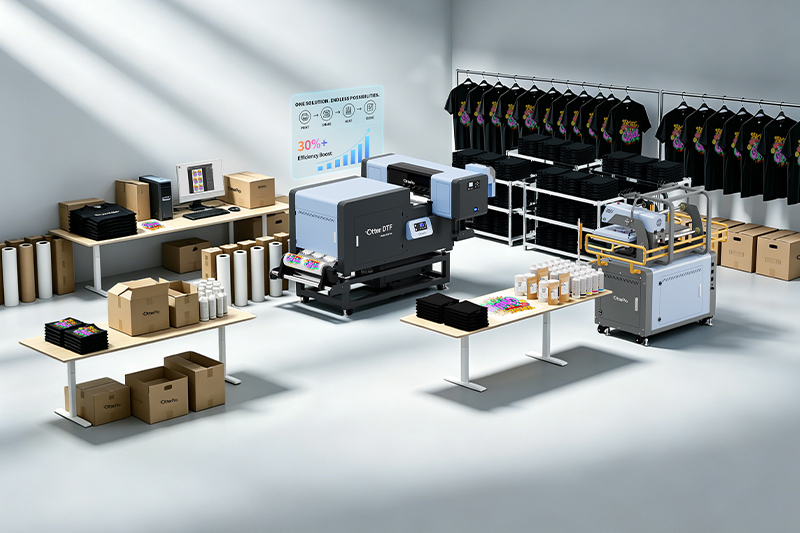
When OtterPro began, DTF was the entire business. We built our first machines for printers who needed to put full-colour artwork onto fabric quickly — without the setup cost of screen printing, and without the fabric restrictions that make sublimation unsuitable for cotton.
That narrow focus taught us something we did not expect. The printer was rarely the part that decided whether a shop survived its first year. What decided it was everything around the printer: the film, the powder, the ink, the curing, the press settings, and whether someone answered the phone at eleven at night when a job was due the next morning.
What DTF actually changed for our customers
Before DTF, a small print shop had two realistic options for dark garments: invest in screen printing setups that only made sense above a few hundred pieces, or send the work out and lose the margin. DTF removed that trade-off.
- Full-colour transfers on cotton, blends, polyester and dark fabrics, with no pre-treatment and no weeding
- Short runs and one-off pieces became profitable, not just volume orders
- One printed sheet could serve many different garments, so stock risk dropped sharply
- Designs could be revised between jobs without burning new screens
For a lot of our customers, that was the difference between offering customisation as a side service and building a business around it.
Why we did not stay a DTF-only company
As those businesses grew, their orders changed shape. A shop that started with T-shirts was soon asked for branded tumblers, phone cases, acrylic signage, tote bags, padded jackets and sports jerseys. Staying strictly in DTF would have meant watching our customers buy their next machine somewhere else.
So we expanded along the work, not along the catalogue:
- UV DTF for hard surfaces — glass, acrylic, metal and packaging — where a heat press is not an option
- Heat presses in every format, from compact swing-away units to large-format and dual-station air presses
- Sublimation ovens and mug presses, because mugs and tumblers are still the highest-volume personalised product in most markets
- Consumables — film, powder, ink — because inconsistent supplies cause more failed prints than machines do
Each addition came from the same question: what is stopping this customer from taking the next order? Sometimes the answer is a printer. Often it is a press, a dryer, a roll of film, or a setting nobody explained properly.
The part that deliberately did not change
We kept three things fixed while the range grew.
First, factory-direct supply. We do not add a layer of distribution between the production line and the print shop, because that layer is where price and accountability both get diluted.
Second, engineering support rather than order support. When a customer reports banding, ghosting or a colour shift, we want the conversation to be about ink viscosity, humidity and press pressure — not about tracking numbers.
Third, honest specifications. A machine that is rated for a job it cannot hold steady will cost the buyer far more than the price difference on the quote.
Where this is going
Print businesses are being asked to do more with less space, less staff and shorter deadlines. The equipment that wins in that environment is the equipment that needs less babysitting: automatic pressing, reliable powder control, and consumables that behave the same way on the hundredth roll as on the first.
That is the direction we are building in. DTF is where we started, and it is still what we are known for — but the goal was never to sell one kind of machine. It was to be the supplier our customers call before they take on something new.